4495e1322f9e4c2ea4c3901c8d5af5ad

Sunday, 7 September 2008

Cyprus - The Island of Aphrodite


Fast Facts

- 3rd Highest GDP per capita in the European Union

- Non-Residents investors may freely repatriate proceeds
from any investments

- Capital: Nicosia

- Population: 800 000

- Currency: Euro (€)

Economic Overview

'The island of Cyprus is also called the Island of Aphrodite, which in Greek Mythology is the goddess of beauty and love........'

'This museum is boring !! Let's go and demolish a plate of calamari, finish off a few bottles of graca and then check out the nightlife !! :)'

Officially the Republic of Cyprus is a Eurasian island country situated in the eastern Mediterranean, south of Turkey, west of the Levant, north of Egypt, and east of Greece.

Cyprus is the third-largest Mediterranean island, and one of the most popular tourist destinations, attracting over 2.4 million tourists per year. A former British colony
(why are we not surprised?!), it gained independence from the United Kingdom in 1960 and became a Commonwealth republic in 1961. The Republic of Cyprus is a developed country and has been a member of the European Union since1 May 2004.

The island in itself is effectively partitioned by the "Green Line" - dividing the two parts from Morphou through Nicosia to Famagusta - with the northern third inhabited by Turkish-Cypriots and the southern two-thirds by Greek Cypriots. The border is patrolled by United Nations troops. (Just in case........)

Cyprus acceded to the EU in 2004 and in July 2007, the currency was locked into the Euro. From 1st January 2008, the Cyprus Pound was replaced by the Euro, with one Euro worth 0.585274 Cyprus Pounds.

Since its accession to the EU, Cyprus has tightened its fiscal policy, following a slippage in 2003 which saw a general government deficit of 6.3% of GDP. The deficit was reduced to 4.2% in 2004, and only 1.2% in 2005 which is well within the EU prescribed 3% of GDP ceiling.

The Cypriot economy saw good growth in 2007, recording 4.4% GDP growth.


Since the heady days of the 1980's, there has also been a significant decline in inflation which recorded a very respectful 4.6% in April 2008.


In February 1997, the government revised its policy on foreign direct investment, permitting 100% foreign ownership in certain cases (Whoooohoooo !!). Regulations on foreign portfolio investment in the Cyprus Stock Exchange also have been liberalized as well.

Cyprus has concluded treaties on double taxation with 26 countries, including South Africa, and has removed exchange restrictions on current international transactions. Non-residents and foreign investors may freely repatriate proceeds from investments in Cyprus. (Gotta love that !!)

Property Market Review

The past year and a half have been quite extraordinary in Cyprus in terms of house price growth. The island is enjoying an extraordinary property boom after a long period of gentle house price rises.

Liberalization of the financial sector, a decrease in interest rates, and increased demand for higher quality housing and second homes as well as the introduction of VAT on the sale of new property, are the main drivers for the recent price increases.

Under the EU accession treaty, VAT on land purchases should've been introduced on 1 January 2008. This has helped create overnight price rises, as all new properties bought since the January 1st deadline are subject to 15% VAT on the value of the land, whereas all properties bought before this time were not. (So the idea was to buy before VAT is scheduled to be added on !!!)

However, the Cypriot government were able to postpone (don't know how they managed that??) the implementation of the VAT on land to July 1, 2008, then to August 1, 2008. Real estate agents capitalized on the confusion by enticing buyers to buy before prices increased with the imposition of VAT.

Look at what this 'enticing' did to the house price growth:


So as you can see, after good solid growth since middle 2006, it was 2008 and beyond which caught the eye !!

EU nationals who are resident in Cyprus may own as much property as they wish, but Non-resident EU nationals, may own as much land as they wish (awesome news !!)

But if Non-resident EU nationals (that's us Saffers) wish to buy any other sort of property, ownership is restricted to one house or one apartment for which approval from the 'Council of Ministers' is needed. Regardless of their residency status, nationals of non-EU countries must seek the approval of the Council of Ministers before they can own any type of immovable property.

Conclusion

The first question you'll ask me is 'Has Cyprus had its day & has the growth in property prices come and gone?' The answer is YES........ and NO.

YES = Due to the extraordinary situation in becoming part of the EU & by postponing the introduction VAT, house property growth has shot through the roof (excuse the pun :) thereby curtailing the historic stable growth figures once experienced before EU ascension.

NO = Cyprus is now part of the EU which promotes stability and growth to its member countries and therefore growth will continue....... albeit at a slower rate than before.

(Sources: http://www.globalpropertyguide.com/ , http://www.wikipedia.org/ ,Daily Telegraph, http://www.iafrica.co.za/ )

Sunday, 3 August 2008

United Kingdom - The Land of Fish and Chips


United Kingdom – The Land of Fish and Chips

Fast Facts

· 2nd Biggest Economy in Europe
· No restrictions on foreign ownership when buying property.
· Capital: London
· Population: 60 million
· Currency: British Pound (£)

Economic Overview

‘Oi !!.......you there, Wha’ fish you wan wiff them chips, then? I aint sellin’ no chips with no fish, innit’…..

And thus our adventure with the United Kingdom and all its peculiarities get off to a good start. But apart from the adventure, experience and ‘Greener Pastures Syndrome’, what makes this mud island one of the best places, to start your property empire?

The United Kingdom of Great Britain and Northern Ireland, commonly known as the United Kingdom (UK), is a sovereign island country located off the north western coast of continental Europe. The UK is a union of four constituent countries & is governed by a parliamentary system with its seat of government in London, & is a constitutional monarchy with Queen Elizabeth II as the head of state.

The UK is the fifth largest economy in the world & is one of the world's most globalised countries with London being the major financial centre of the world, in front of New York City, Hong Kong and Singapore.

In 2008, a flat in central London sold for £115m, which is believed to be the most expensive apartment the world. (Crazy money if you ask me!) That aside, UK house prices are slowing down & the long-lasting property boom seems over. UK house prices fell by 2.5% in March 2008 which is also the biggest monthly decline since September 1992. To show you what this means in the big scheme of things, have a look at the graph:


As you can see, the house price boom which started in early 1997 has now returned to those levels, and the current future sentiment is anyone’s guess. Mortgage lenders have greatly reduced the amount of loans they are prepared to make & it was recorded that lending to first-time buyers was at its lowest since early 1975.

100% mortgage loans are now no longer offered & borrowers looking for new mortgages are being thrown into complete chaos, as deals they have agreed with their broker, disappear from the market just hours before applications were to be signed. (This also happened to me !!)

So, with all these doom and gloom predictions, will we if ever, return to a hint of normalcy?

Property Market Review

The UK property market is currently in decline thanks largely to the phenomenon called the ‘Credit Crunch’? (Ever heard of it?)

Definition: A credit crunch is a sudden reduction in the general availability of loans, or a sudden increase in the cost of obtaining loans from commercial banks. So, why the ‘sudden reduction in giving out loans? Show us why in Graphs they cry !!

Have a look at the affordability of property prices by the above graph which is the ratio between house prices and earnings. House prices are now 7.0 times earnings in London, 5.7 times in the South West, 4.6 times in the Midlands, 4.5 times in Yorkshire and Humber, and 4.0 times in Scotland.

This means that UK house prices are currently more overvalued now than they have ever been !! (And if I was a bank, I’d also reduce funding until affordability returns to some vestige of normality)

So, what about the ‘upside’? …….(The UPSIDE??!! Are you kidding me??!!)

Apart from the doom-and-gloom scenario as discussed, there are still ‘pockets of light’. Rental incomes have increased at an average of 16.7% over the past year & London yields are showing a very healthy 5.7% .

A major contributor to this yield is immigration which is not only featured in London as many may think. Across the country, the average proportion of properties taken by immigrants is 20% as the UK continues to attract immigrants due to job opportunities (No, this isn’t only us Saffers !!) In addition, the economy remains strong with retail sales in the year to February rose by a stronger-than-expected 5.5 %.

Furthermore, UK house prices have been continually on the rise since 1995. From late 1995 to 2008, average UK house prices have risen from £50,930 to £179,363.This is an overwhelming 252% increase !!

Also, UK house-building has largely failed to respond to booming house prices for the past decade, largely because of building regulations. Increases in population, immigration, and a decrease in unemployment, have all added to the demand for housing as have changes in household sizes.

The Barker Review (HM Treasury), concluded that to reduce the trend in real price inflation to 1.8%, the rate of new home building would have to increase by around 70,000 homes per annum to around 195,000 per annum. Government figures show that homebuilding stagnated at 148,000 new units annually between 1989 and 2005.

In 2006, 180,000 new homes were built which is still low compared to 425,000 units in 1968……..

Conclusion

So forget the credit crunch, affordability & high interest rates, because as long as the UK can maintain its demand for a skilled worforce, the economy will march on unhindered through the storm.

Saturday, 5 July 2008

Dubai - The Land of Oil and Sand


Dubai – The Land of Oil and Sand

Fast Facts
· No Income, Capital Gains or any Property Related Tax.
· Residence Visa is granted to any property purchase.
· Capital: Dubai
· Population: 2.2 million
· Currency: UAE Dirham

Economic Overview

Six thousand years ago, the city of Babylon was the wealthiest in the World. It was a city of incalculable wealth, both loved and loathed across the globe for its opulence and excess.

It was built in the desert on sand and rock & stood for thousands of years, even though many prophesised that Babylon would fall ahead of its time……….Does this sound familiar?

Dubai refers to one of the seven emirates in the United Arab Emirates (UAE).

The modern emirate of Dubai has been ruled by the Al Maktoum dynasty since 1833. The emirates' current ruler, Mohammed bin Rashid Al Maktoum, is also the Prime Minister and Vice President of the UAE.

The Economy of Dubai is valued at US$ 46 billion and has been described as "centrally-planned free-market capitalism." Although Dubai's economy was built on the back of the oil industry, revenue from petroleum and natural gas currently account for less than 3% of the emirate's gross domestic product. (You didn’t know that, did you? :)

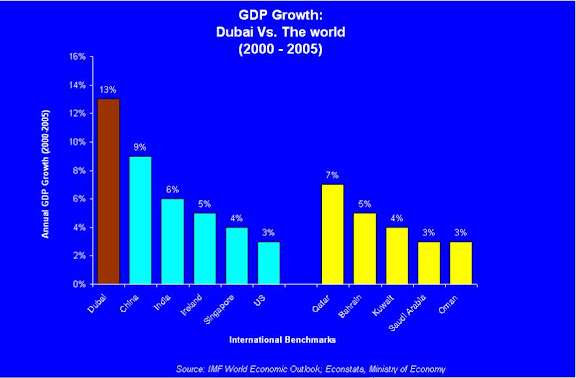
So, for you ‘right-side brain thinkers’, let’s back up all these figures we’re throwing around and look at some graphs:

Now don’t get me wrong,13% GDP growth per year cannot be sustained……….and even if and when this growth recedes, would you still be happy with 5-10%? :)

Dubai is also an important tourist destination and port (Jebel Ali, constructed in the 1970s, has the largest man-made harbour in the world !!). It is also starting to develop as a hub for service industries such as IT and Finance, together with the new Dubai International Financial Centre (DIFC).

(It is rumoured that Dubai’s oil reserves will dry up by approximately 2020, and that is why they need to steer away from oil related industries. Thus far, they’re doing a fatastic job – And did I mention that Dubai was voted safest city in the World by Interpol for the past 4 years?!!)
Property Market Review

Now before I get lambasted on how Dubai is 1) built on sand, 2) the oil is drying up, 3) many property developments are behind on schedule and might never be completed, etc etc……let me just say that for every negative calamity prophesised (remember Babylon?), every one of them has been proved incorrect thus far.

People need to live and work in Dubai. And as a place to do business, as a trading centre, Dubai continues to exceed every expectation.

In March 2008, Standard Chartered Bank forecasted an average growth of 15% in Dubai real estate prices, with net new demand for 70,000 residential units and a supply of only 57,000……….boggles the mind, doesn’t it? :)

Dubai is gaining traction as a place to live and work, despite the stress, heat, noise, and high prices. Staff numbers are surging at the Dubai International Financial Centre, an international financial hub regulated to global standards with its law in English.

Rents continue to rise in line with prices, according to Global Property Guide research. Rental yields range from 10.20% on the smallest units, to 6.88% on the largest units.
Apartments
Size = 50 sq. m.
Cost = $206,400
Yield = 10.20%

Size = 100 sq. m.
Cost = $409,500
Yield = 8.23%
Size = 150 sq. m.
Cost = $605,400
Yield = 7.21%

Size = 200 sq. m.
Cost = $794,800
Yield = 7.00%

Size = 250 sq. m.
Cost = $897,000
Yield = 6.88%

(These apartments are the average of the following Development:
Burj Dubai, Dubai Marina, Jumeirah Beach Residence, Jumeirah Lake Towers & Palm Jumeirah)
Now before I get thumped by the ‘But Brigade’………But what about this?..... But what about that?…..but, but, but…..

Just look at the figures below !!.......and don’t come and tell me that transaction costs are high:
TRANSACTION COSTS

Who Pays? (Buyer)

Title Deed = 250AED

Registration Fee = 1%
Who Pays? (Seller)
Registration Fee = 1%
Real Estate Agent's fee = 1.00% - 5.00%

Average Costs paid by buyer
1.01% - 1.05%
Average Costs paid by seller

2.00% - 6.00%
So what are the benefits of buying in Dubai? And how do we go about it?

Foreign nationals (that’s us) are allowed to buy freehold properties in designated areas in Dubai. Gulf Cooperation Council (GCC) whilst nationals (that’s Dubai residents) are allowed freehold ownership anywhere in the Emirates.

Residence Visas are issued to property owners, which extend to their immediate families. These visas are renewable every three years during ownership. (So much for having to live in London for 5 years before you get a passport :)

Property Development can be either be bought using financing from the different commercial banks in Dubai (Foreigners can qualify for 90% mortgages) or staggered payments to the developer before completion. Once the development is completed and units can be handed over to the buyers, full payment of the purchase price must be made.

Combine this favourable buying process with No Income tax, Capital Gains or any Property Related Tax, and you have an almost perfect investment environment.

Conclusion

This modern day Babylon seems to defy logic with its incredible vision of wealth and splendour. But the questions remain:

‘When will it all end?’ ‘And will Dubai crumble and return to the sands on which it was built?
‘Or, will this city prosper and emulate the Babylon of old?

I for one back the latter.

(To view our current Dubai Developments, please click HERE

Tuesday, 1 July 2008

How and Why and When??

One of my favourite movies is 'Gattaca' where the world is devided into the super-elite, and the rest make up the 'degenerates'. But isn't this what the world is like right now, due to our own human nature?

When I started this journey, I believed that with hard work, honest opinions on which property market was set to boom (or not), and to provide the level of service that would set us apart from the rest would push Horizon into the 'super-elite'. And the truth is, I still firmly believe that we are capable of this :) It's just gonna take a little time...........

My business partner, Francois de Wet and myself completed our financial statements of our first year of incorporation. And although 'things can only improve' (Thanks for that, Francois :), I'm sure that things will go from strength to strength.

So let's get to the 'How' ?:

In his book 'How to get Rich', Felix Dennis says that the reason to get rich is not only to enjoy the benefit of what money can buy, but to be able to enjoy 'Time'. Now this might seem a tad strange for someone as wealthy as himself, but please bear with me........

Time allows us to enjoy life by providing us with no constraints to do so. Make sense? :)

And now the 'Why' ?:

I get asked this question very often and it always surprises me. Why do you work so hard? Why do you want to own your own company when you already have a day-job? Why would you succeed when so many have failed?

The answer is simple really: I have been given every opportunity to succeed in life........So what is my excuse when I do not?

And last but probably the most important question, 'When'?

In Horizon's business partnership, I am the impulsive / not tomorrow but today / sales type person. I want it NOW !! But then I have Francois who quietens things down and looks at the world with a quite perspective.

So if I may, I'll compare the answer to the Lottery (which I don't believe in, but that's another story altogether........) It is a proven fact that 90% of people who win the lottery will lose ALL of it within 5 years. The reason for this is because they were entrusted with 'too much too fast' and with no discipline to manage rather than spend..............it'll just be a waste.

To conclude, our little venture may be taking its time to go forth and conquer. But 'A journey of a thousand miles, starts with the first step'.

Tuesday, 17 June 2008

Moving into the Middle East......

After weeks of red tape, Horizon Consultancy is finally an Authorised DAMAC Property Agent !!

If you don't know, DAMAC Properties is the largest private property developer in the Middle East, specializing in offering outstanding returns, on Off-Plan property investments. 

DAMAC Properties was established in 2003 and has grown into one of the most successful residential, leisure and commercial developers in Dubai and the Middle East. DAMAC is also expanding rapidly into North Africa, Jordan, Lebanon, Qatar, Saudi Arabia and the Far East.

Notable Developments by DAMAC are:

- DAMAC Heights, Dubai Marina, Dubai 

o For information on this Development, please click HERE 

- Lincoln Park, Dubailand, Dubai

o For information on this Development, please click HERE

- Marina Bay, Abu Dhabi

o For information on this Development, please click HERE 

- Hyde Park, New Cairo, Egypt

o For information on this Development, please click HERE 

Developments can be acquired using a Payment Structure or Financing of up to 90% (yes, that includes Saffers as well !!) by a local Commercial Bank in Dubai or wherever the property in located.

If you would like more information on the above Developments or on purchasing property in the Middle East, please click HERE

Monday, 2 June 2008

A Guide to Buying Property Abroad

by Sarah Scrafford 

It’s extremely easy to make mistakes that have severe financial consequences when buying and selling real estate, more so when the property you have your eyes on is located overseas. Here are a few things to consider before finalizing the papers on that home or piece of land abroad: 

  • Don’t believe all that you hear or read about the property. It’s wise to make a couple of visits and go over the place before you even think of buying.
  • Deal only with agents who are authorized and legit.
  • Check if the seller is within his rights to sell that particular property to you – you don’t want to be caught on the wrong foot paying good money for property that’s caught up in a legal wrangle or other problem.
  • Familiarize yourself with that particular country’s real estate laws and if possible, find a good local lawyer who can guide you through the process.
  • If you plan to renovate, go through the planning permission rules with a fine-tooth comb to make sure you don’t breach any laws.
  • Open a bank account local to the country you’re buying property in. It eases your financial transactions.
  • Your country’s embassy can help in educating you about local taxes and work permits.
  • Don’t rush the process – take as long as you can to make sure you’re not given the short end of the stick.
  • Make sure you’re not quoted a higher rate just because you’re a foreigner.
  • Retain an alternative housing arrangement in case the deal falls through.
  • In case you’re paying for a house that’s yet to be built, ensure that your insurance is in order.
  • If the company you’re buying the property from is a member of the Federation of International Property Developers, it’s an added plus point.
  • The rules and regulations governing foreign property purchases vary from country to country.  
  • Talk to other fellow countrymen who have bought property in the same country to get information, views and opinions.
  • Don’t buy property overseas just because there’s a current housing boom and you hope to cash in later.
  • If you think a deal is too good to be true, check it out again and again until you’re sure there are no loopholes. 

Investing in property is a financial decision that can either pay rich dividends or get you deep in the red, depending on how wise (or foolish) you are. So be informed, be savvy, and be careful when buying property in a foreign country.  

About Sarah:  

Sarah Scrafford is an industry critic, as well as a regular contributor on the subject of entrepreneurship. 

She invites your questions, comments and freelancing job inquiries at her email address. To contact her, please click HERE


Sunday, 1 June 2008

Investment Opportunity - London, United Kingdom (£239,999)

Property in the United Kingdom has always been a good investment, but the best returns have always been experienced in the capital, London. Reasons for this include a rampant Rental Market due to the steady influx of Foreigners, Low interest rates & steady growth for the past 10 years.

But now London finds itself in a Buyers Market which bodes well for the informed investor. One such 'Buyers Opportunity' includes the following property that is up for sale:

The Property is situated in the South West of Central London in an area called, Southfields. 

(Click HERE for the location)

Details of Property: 

This newly decorated bright and attractive two bed roomed first floor flat in Southfields features a modern open-plan reception room/kitchen with a stylish interior. 

The property further comprises of two well proportioned bedrooms, a newly installed bathroom and ample storage space in the hallway. Situated on Bell Drive, Southfields the green open spaces and woodland walks of Wimbledon Common and Putney Heath are within easy reach, whilst the shops, bars and restaurants of Southfields are also nearby. 

The nearest station is Southfields Underground station that is a 12min walk away (District Line), which provides regular services to central London and London Victoria (for Circle and Victoria lines and British Rail services to Gatwick Airport). Regular bus services (2 every 10mins) also stop nearby that’s travels to Putney town centre within 5 mins.

Features of the Property: 

  • Totally re-furbished in July 2007
  • New combination Boiler and Central Heating Network (Boiler under warrantee)
  • Integrated fridge & freezer (under warrantee)
  • Newly installed Oven, Hob and Extractor Fan (under warrantee)
  • Newly fitted Bathroom
  • Two big hallway storage cupboards
  • Main Bedroom build-in cupboards
  • Ample free off-street parking
  • Flat is sold fully furnished !! 

Financials of Property: 

  • Potential rental income: £1050 - £1100/calendar month
  • Service Charge: £450/calendar year
  • Lease: 107 years remaining

If you require more information on this property, please contact me HERE

Sunday, 25 May 2008

Property Review - Mauritius


Mauritius – The Jewel in the Indian Ocean

Fast Facts

• No Capital Gains & Inheritance Tax.
• Recorded an average of 5% economic growth since 1968.
• Capital: Port Louis
• Population: 1.2 million
• Currency: Mauritian Rupee

Economic Overview

‘I wonder what it would be like to live in Paradise?’ Soft sandy beaches, Turquoise seas teeming with sealife……….and then you get to call this paradise……..Home :)’

But would you still consider it to be paradise once the novelty wore off? And would boredom soon set in, once you had ‘conquered’ the fishing, surfing, exploring…….?

République de Maurice (or Mauritius) is an island nation off the coast of the African continent, in the southwest Indian Ocean. In addition to the island of Mauritius, the republic includes the islands of St Brandon, Rodrigues the Agalega Islands. Mauritius is part of the Mascarene Islands, with the French island of Réunion to the southwest, and the island of Rodrigues to the northeast.
Mauritius attained independence in 1968 and the country became a republic within the British Commonwealth in 1992. The country has been a stable democracy with regular free elections (Yes, this can happen……..even in Africa !!), and a positive human rights record which has attracted considerable foreign investment, earning one of Africa's highest per capita incomes.
Since 1968, Mauritius has developed from a low income, agriculturally based economy to a middle income diversified economy with growing Industrial, Financial, and Tourist sectors.
For most of the period, annual growth has been of the order of 5% to 6%. If you don’t believe me, look at the graph :

And with a sustainable GDP per capita that impressive, it’s no wonder the country has the seventh-highest GDP per capita in Africa !!

The government's development strategy centres on Foreign Investment. (This is where things getting really interesting………) Thus far, the country has attracted more than 9,000 offshore entities; many aimed at Commerce in India and South Africa. The investment in the banking sector alone has reached over $1 billion !! :)

In order to provide residents with access to imports at lower prices and attract more tourists going to Singapore and Dubai, Mauritius is gearing towards becoming a duty-free island within the next four years.(Not that they would EVER admit to copying the idea from Dubai…….) And just to reiterate their stance on this Duty Free Issue, the Finance Minister, Rama Sithanen in the 2007-2008 Budget, reduced the corporate tax to 15%.

Mauritius has also drawn up plans to become the first nation to have coast-to-coast wireless internet access. (Can you imagine what this will do for the already fast growing Economy??!!) The wireless hot spot currently covers about 60% of the island and is accessible by about 70% of its population………

Property Market Review

The Mauritian government’s new Development Strategy, has only recently made it possible for foreigners to own property. This strategy is divided into 3 Government Schemes’:

1) Permanent Residence Scheme (PRS):

a. Under the PRS, the foreign investor can purchase up to 5,276 m2 of residential property which must be at least 100 meters away from the sea.
b. A minimum investment of US$500,000 is required.

2) Integrated Resort Scheme (IRS):

a. Under the IRS, foreigners can purchase luxury villas of up to 5.276 m2 each.
b. As a property-owner, a residency permit is also granted, which is extended to the investor’s family. (How awesome is that??!!)

3) Scheme to Attract Professionals for Emerging Sectors (SAPES).

a. SAPES is an incentive to encourage professionals to work in Mauritius, and allows foreign professionals to acquire residential property.

Mauritian Rental Law is generally pro-tenant & sets out 2 important elements to renting:

1) Rent:

a. The initial rent is regulated by the Fair Rent Tribunal and cannot be changed within the first three years of tenancy.

b. Rent increases must be justified by the landlord.

2) Tenant Security:

a. A landlord must go through the court system when evicting a tenant, as only District Courts have the power to evict.

b. In case of eviction due to landlord’s use of the property, the court can order that the tenant be compensated for any prejudice suffered.

But rental yields still give us a healthy 6.17% as below:

RENTAL YIELDS – Port Louis

To Buy:

100 sq. m. = $85,000
200 sq. m. = $160,000
300 sq. m. = $250,000
500 sq. m. = $350,000

Yield:

100 sq.m = 4.24%
200 sq. m = 4.50%
300 sq. m = 5.76%
500 sq. m = 6.17%

Probably the only thing keeping Foreigner out of Mauritius at the current moment (this is both a good and a bad thing………but I’m confident that this will change) is the high Transaction costs…….

TRANSACTION COSTS

Notary’s Fees = 0.5% - 2% (+15% VAT) (Buyer Pays)

Agency Fees = 1% (+15% VAT) (Buyer Pays)

Registration Fee = 10% (Seller Pays)

Transfer Tax = 5% (Seller pays)

Site Plan = US$1,606 (Seller pays)

Stamp Duty = US$5 (Seller pays)

Costs paid by Buyer 1.725% - 3.45%

Costs paid by Seller 18.04%

………and then the high Rental Income Tax costs:

EFFECTIVE TAX RATE ON RENTAL INCOME

Monthly Income (Tax Rate%)

US$1,500 = 12%

US$6,000 = 16.7%

US$12,000 = 17.4%

But there being no Capital Gains tax, these costs are still very reasonable……………as long as you follow the old adage,’ You make your money when you BUY, and not when you SELL’:

Conclusion

In the past, Mauritius has definitely had its share of problems: bad weather which affected the sugar cane crop which in turn affected the economic output / growth.

But now that the government has started making a concerted effort to create a ‘Mini-Dubai’, I believe that Mauritius is geared to explode onto the international scene in the next few years………..but shhhhhhhhhh, and don’t tell anyone :)

Saturday, 19 April 2008

Property Review - Egypt


Egypt - The Land of the Pharoahs

Fast Facts

· GDP growth currently at 7%

· No capital gains or inheritance tax.

· Capital: Cairo

· Population: 80 million

· Currency: Egyptian Pound

Economic Overview

'I don't where to go first, the Pyramids of Giza or the Valley of the Kings? Why not do both and even add on a Red Sea scuba dive in Sharm El Sheikh'? Well, that depends on how much time you have? Oh.........about a week'

You might need a little longer than that, as you'd only be able to cover half of Cairo in a week J'

Officially, the Arab Republic of Egypt, is a country in North Africa that includes the Sinai Peninsula, a land bridge to Asia. It borders Libya to the west, Sudan to the south and the Gaza Strip and Israel to the east. The northern coast borders the Mediterranean Sea; the eastern coast borders the Red Sea.

Egypt declared its independence from Great Britain in 1922 and only became a Republic in 1953. Hosni Mubarak became Egypt's 4th President in 1981 since being declared a Republic and is currently serving his 5th term in office.

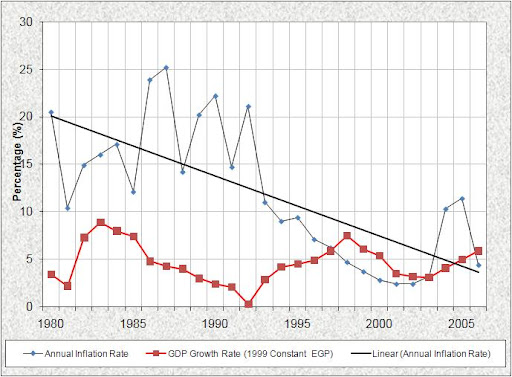
Under comprehensive economic reforms initiated in 1991, Egypt has relaxed many price controls, reduced subsidies, reduced inflation, cut taxes, and partially liberalized trade and investment. This has promoted a steady increase of GDP, as well as the annual growth rate. The Government of Egypt tamed inflation bringing it down from double-digit to a single digit..........Wanna see?! :)


And yes, I PROMISE that this graph is correct as the nosedive from 25% inflation in the late 1980's is truly incredible !! And just to top that, GDP is currently rising smartly by 7% per annum due to a successful diversification.

Egypt is currently, truly coming into its own and the emerging sectors such as IT Sector and the Investment Climate (yay !! :) are showing the way !!
The Egyptian IT sector has been growing significantly since it was separated from the transportation sector. The market for telecommunications market was officially deregulated since the beginning of 2006 according to the World Trade Organisation agreement.

The government established the Information Technology Industry Development Agency (ITIDA) as governmental entity. This agency aims at paving the way for the diffusion of the e-business services in Egypt, capitalizing on different mandates of the authority as activating the Egyptian e-signature law, and supporting an export-oriented IT sector in Egypt.

The Egyptian equity market is one of the most developed in the region with more than 633 listed companies. Market capitalization on the exchange doubled in 2005 from USD 47.2 billion to USD 93.5 billion, with turnover surging from USD 1.16 billion in January 2005 to USD 6 billion in January 2006.

Property Market Review

After years of only state-built housing, in the early 1990s the government allowed private housing projects. And guess what happened? Inexperienced companies jumped in and soon you had a massive oversupply which soon ended up with many Developers going bankrupt (Will they never learn?! : )

But now, the situation has changed.........WHY? (do I hear everyone shout !!)

Well, if you wait a second, I'll tell you........:

- Egypt offers excellent rental income returns.

- The Gulf is now exploding with new oil money, and sees Egypt as less risky than Lebanon or Jordan.

- Egypt has a rapidly-growing economy (remember the 7%?) with a fast-growing outsourcing sector.

- There is enormous European interest in Red Sea property.

The government initiated a managed float of the Egyptian Pound in January 2003, leading to a sharp drop in its value which has since recovered. And what happens when a currency weakens against international currencies, and you have a significant Expat Community? They start buying of course !!! And so did everyone else............

The passing of the Real Estate Finance Law in May 2001, created a mortgage market. (Can you believe that it took them this long??!!!) For the first time since the 1948 civil code, banks can now repossess properties and evict owners who default on loan repayments.

Total mortgage lending is expected to grow rapidly to LE 4 billion (US$690 million) by the end of 2007, as the Egyptian Company for Mortgage Refinancing (ECMR) begins operations. ECMR is likely to help lower interest rates, which have hitherto been an obstacle to lower income groups. Lending rates in the 12% - 14% range have discouraged housing purchases, but in turn increased rentals due to affordability.

Now, let's start at how we as 'Foreigners' can secure property in the Land of the Pharaohs:

Foreigners can buy property in Egypt, under Law No 230 of 1996. (Well, that's a start J) But, foreigners cannot buy more than two pieces of real-estate, and the purchase must have the approval of the Council of Ministers, which takes around two months.

Property in Sharm El Sheikh follows a different regime where foreign purchasers in cannot acquire freehold rights, but only 99 year leases. Foreign purchasers must therefore follow a procedure called a 'signature validity court verdict'.

The 'signature validity court verdict' method could well become the dominant route for foreigners, because it allows the foreigner to buy as many properties as he likes, rent them, and sell when he likes.

The following steps must be taken:

1. A 'negative' certificate for the property should be obtained from the government, stating that there are no mortgages, pledges, or any other sort of rights on the property registered to any other party.

2. The tax authorities must issue a certificate stating what taxes are due on the property.

3. A sale / usufruct contract should be drawn up.

- The validity of the sale depends on the terms of the contract.


- So it is essential for the purchaser to have a detailed contract, defining the property boundaries, the purchase price, the method of the acquisition of the rights of the previous owner, and the method of payment.

- The contract must be in Arabic, since Arabic is the only language recognized by the courts. (very NB !!)

4. Purchasers must issue a power of attorney to their lawyer so that he can act on their behalf, a procedure which requires the purchaser to obtain a multi-entry visa:

- Then the lawyer files a legal suit to obtain a court verdict certifying that the signature on the sale / usufruct contract truly belongs to the seller

(This is the 'signature validity court verdict').

- This suit will take between 6-8 months.

It's always very important to have a look at the transaction costs involved when making your purchase, and to give yourself an idea of the 'hidden costs' involved, have a look at this table:

Transaction Costs

- Registration Fee EGP500 - EGP2,000 buyer

- Legal Fees 3% buyer

- Real Estate Agent's Fee 2.75% - 3.30%

- Transfer Tax 2.50%

- Capital Gains Tax 2.50%

- Costs paid by buyer 3.10% - 4.00%

- Costs paid by seller 7.75% - 8.30%

- Roundtrip Transaction Costs 10.85% - 12.30%

Source: Global Property Guide

Now that you have had a look at the Purchase Procedure, let's have a look at what the results could be once you do decide to buy. Here is the graph of Rental Yields & Property Prices per Type of Unit for Cairo:


CAIRO - MAADI - Apartments

Size: 250 sq.m.

COST (US$)

136,000

YIELD (p.a.)

17.32%

CAIRO - MOHANDESSEEN - Apartments

Size: 250 sq.m.


COST (US$)

149,750

YIELD (p.a.)


8.01%

CAIRO - ZAMALEK - Apartments

Size: 250 sq.m.


COST (US$)

294,750


YIELD (p.a.)


6.84%

Source: Global Property Guide


So the question is: Would you buy in Maadi at 17% Rental Yield?

YES I would !!! :)

Therefore, the transaction costs in itself are not too expensive, but it's the Buying Process that needs VERY careful consederation.................as it gets pretty complicated !!

Conclusion

Although all the economic and property market indicators, correctly point to Egypt as a awesome viable investment destination, there is 1 thing that bothers me:

Egypt relies heavily on tourism.

The tourism sector suffered tremendously following terrorist attacks on tourists in Luxor in October 1997,Sharm al-Sheikh in July 2005, and the town of Dahab in Red Sea resort in April 2006. And therefore, any type of terrosist attack can upset the entire region, and bode badly for the investor.

Other than that, at properties priced starting at £19k, who'll NOT be buying?

(Sources: http://www.globalpropertyguide.com/ , http://www.wikipedia.org/ & Daily Telegraph)

Monday, 10 March 2008

How to buy Overseas Property as a Foreign National?


‘Is it just me, or is the World getting smaller?’

You can get on an airplane, and in 24 hours you’re at the other side of the World !! (Be it New Zealand, New York or even Tokyo for that matter) And with this ability to travel, comes the possibility of investing in property in all 4 corners of the Globe (except in the countries where they have a Bob…..or a Fidel / Raul, who are in charge :(

South African property in global terms, is not as cheap as it was a few years ago, but many Saffers are still under the impression that it is. Therefore, the idea of investing in other countries, has just simply not occurred to us………

But, as South Africans, there are limits to this ‘abundance’ of investment potential. The main factor is due to the current foreign exchange controls that South Africa has in place. These controls stipulate that no South African National may take more than R2m out of South Africa in his / her lifetime.

With this in mind, let’s take a look at buying Overseas Property...........

So why Overseas Property?

1) Overseas Property allows you to protect against economic / political uncertainty.

2) It protects you against the devaluing of the Rand.

3) It allows you to take advantage of booming world economies such as India & Brazil.

4) Some countries such as Mauritius, provide you with residency if you buy property.

So where should I buy?

I’d be telling ‘porkies’ if I told you that this decision is due to research...........because the answer would be LOTS and LOTS of research !!

The Move Channel which is a popular search engine for overseas property ranks the following markets as good investments: Australia, Brazil, Bulgaria, Canada, Canary Islands, Cape Verde, Cyprus, China, Czech Republic, England, Estonia, France, Germany, Greece, Hungary, India, Italy, Latvia and Morocco.

But my choice would be the ‘New World Economies’ which would provide the best property and rental growth. Areas such as Brazil, India, Eastern Europe, certain Caribbean countries as well as Egypt, Morocco and Mauritius are definitely the way to go.

For example, in the Dominican Republic you don’t pay capital gains tax, you get residency and very often Developers can provide financing instead of the local banks.

How much does it cost?

So this is what all investors will look at……….the Cost !! But read on as you might be surprised to hear what overseas property costs :)

Studio apartments in Bulgaria, around the Red Sea or in Brazil start at less than R800 000 which is a bargain compared to what a similar property would cost in Cape Town’s CBD (let’s not even start with how expensive that is……)

Factors to consider before buying?

1) Go on an Inspection Trip or an Overseas Property Exhibition:

Inspection trips are usually package tours that aim to give you an overview of what the properties will look like once it has been built

Tip: You can also consider this as a ‘free holiday’ if you decide not to buy :)

2) Arranging Finance:

If you can, pay the full price in Cash.

Many of the emerging countries do not have banking systems that are as refined as in South Africa.

Tip: No jokes……….South Africa has one of the best banking systems in the World !!

3) Seek Specialist Advice:

Seek specialist advice from estate agents, solicitors, architects and surveyors in the country where you plan to invest.

Ask questions, including costs that the local authorities may charge, but that you might not be used to paying when buying property in South Africa.

Tip: There are ALWAYS hidden costs with overseas purchases, so make sure that you are aware of any ‘extra’ costs that might come your way !!

4) Open a bank account in the country where you choose to invest:

Some countries require a Certificate of Importation for any money you bring in from South Africa.

Tip: A local bank account allows you to monitor all revenues / costs more affectively, as it is displayed in local currency.

5) Make your offer in Writing:

Ensure that your offer is subject to the signing of a Contract.

Tip: This sounds seriously obvious, but okes still get this wrong !!

6) Never sign a contract in a language you do not understand:

The contract should include a clause stipulating that the English contract takes precedent in the event of a clash with the contract in the local language.

Tip: Probably the most important factor of all !!